Ready to strengthen your interoperability strategy?
Explore how Greenway Health helps ambulatory practices connect to established networks, streamline workflows, and turn data into action.
Friday, October 09, 2026

Healthcare organizations have made significant investments in digital transformation, yet many still face a common challenge: ensuring the right information reaches the right provider at the right time. Integration with established networks provides the foundation for health information exchange, helping make connected data accessible when and where providers need it.
In fact, KLAS research found that 47% of clinicians cannot quickly find important patient information from outside organizations, while another 47% report having to sift through duplicate data to locate what they need. Every minute spent searching for records, reconciling information, or navigating disconnected systems is time that could be spent caring for patients.
A patient’s healthcare journey rarely occurs within a single organization. Primary care practices, specialists, laboratories, imaging centers, pharmacies, and hospitals each contribute to pieces of the patient story. However, when those pieces remain fragmented across different systems, providers often lack a complete view of the information needed to support timely clinical decision-making.
This is why established healthcare networks have become a critical foundation for modern health information exchange (HIE). By creating trusted pathways for secure data sharing, these networks help healthcare organizations exchange information across care settings without the complexity of maintaining countless point-to-point connections.
However, connectivity alone is not enough. Effective interoperability requires information to flow directly into clinical workflows, strong alliances that make data sharing dependable, integration solutions that reduce administrative burden, and measurable strategies that ensure long-term success.
In this article, we’ll explore five key pillars of connected ambulatory care:
Together, these pillars create a more connected healthcare ecosystem where information moves efficiently, workflows become more productive, and providers regain valuable time for patient care. That’s the vision behind Novare™ by Greenway Health: leveraging interoperability, established networks, and intelligent integration to turn connectivity into capacity and capacity into better care.
The fastest path to seamless data sharing is not building new connections from scratch. It’s participating in established networks that already provide the scale, security, governance, and reliability modern healthcare organizations require.
The true value of a health information exchange is participant density. The more providers, health systems, laboratories, payers, and healthcare organizations connected to a network, the more valuable the network becomes. Established networks eliminate the cold-start problem by giving practices immediate access to a broad ecosystem of participants rather than requiring hundreds of individual integrations.
The infrastructure for broader data sharing is already taking shape. According to a 2024 ASTP/ONC data brief, four in five HIE organizations nationwide make laboratory results available to participating organizations, highlighting the role established networks already play in making clinical information available across participating organizations.
When practices connect through trusted health information exchange networks, they can extend their access to patient information without relying solely on individual point-to-point connections. The result is a stronger foundation for interoperability, data sharing, and more efficient workflows, helping return valuable time to patient care.
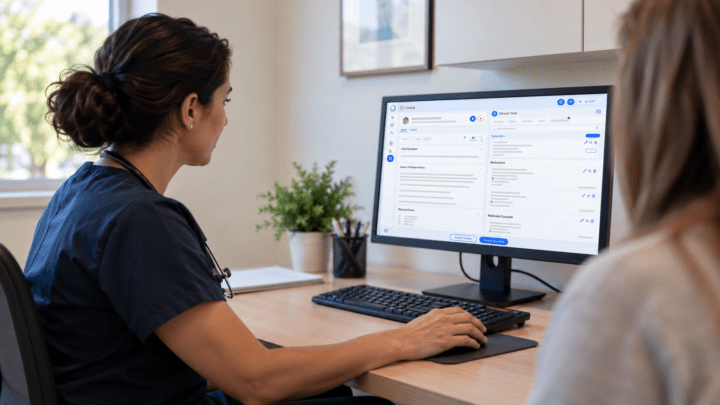
While many organizations view interoperability as a technical objective, its real value is experienced by the people delivering care. Ambulatory physicians already spend an average of 5.8 hours in the EHR for every eight hours of scheduled patient care, with primary care physicians averaging 7.3 hours, according to research highlighted by the American Medical Association.
Interoperability alone cannot eliminate that workload, but it can help reduce unnecessary friction by making outside information easier to find and use. When relevant patient information is available before the visit begins, connected systems help assemble a more complete patient story, allowing clinicians to spend less time searching for records and more time focused on care.
As a result, practices benefit from greater speed, fewer handoffs, and reduced administrative burden. Teams spend less time tracking down information and more time delivering care. Improved workflow efficiency can also contribute to higher clinician satisfaction and reduced operational stress and cognitive load.
The most effective integrations do more than transfer information. They present concise, actionable summaries and place relevant data directly within existing workflows.
Through Novare-powered connectivity capabilities, practices can automatically locate outside records, reconcile external medications and diagnoses with a single click, and support secure third-party application connections through Fast Healthcare Interoperability Resources Application Programming Interfaces (FHIR APIs).
Sustainable data sharing depends on more than technology alone. It requires ongoing collaboration among software vendors, healthcare organizations, payers, and interoperability networks.
This is where strong alliances become critical.
Greenway Health participates in national interoperability initiatives and connectivity frameworks designed to simplify information exchange for ambulatory practices. Through relationships with organizations such as CommonWell and Carequality, practices benefit from dependable connectivity without needing to build and maintain complex integrations independently. CommonWell has also been designated as a Qualified Health Information Network (QHIN) under Trust Exchange Framework and Common Agreement (TEFCA), helping advance nationwide interoperability efforts.
Practices benefit from:
These strong alliances help ensure that interoperability remains dependable, scalable, and aligned with evolving healthcare requirements.
Not all integration solutions are created equal.
The best integration solutions remove work from users and simplify processes. The wrong solutions simply introduce additional dashboards, duplicate workflows, and management overhead.
Healthcare leaders should evaluate solutions through the lens of operational impact, not technical features alone.
When evaluating integration solutions, consider:
Additional questions may include:
The goal is simple: select integration solutions that reduce friction, streamline workflows, and create long-term value.
Successful interoperability initiatives often follow a phased approach that minimizes disruption while accelerating time to value.
Assess (0-30 Days)
Integrate (30-180 Days)
Optimize (180+ Days)
Including clinical informatics, security leaders, and frontline staff early in the process helps build adoption and turn interoperability into a lasting organizational capability.
Interoperability delivers measurable value when connected information becomes available and usable within the workflows where care decisions happen.
Clear metrics help transform integration solutions from a technical initiative into a strategic business driver. Healthcare organizations should measure not only whether information can move between systems, but whether providers can easily find, reconcile, and use that information while delivering care.
Recent research highlights the opportunity. Among 4,107 family physicians surveyed, only 32% reported often automatically receiving medication information from outside sources in their EHR, and just 13% reported both receiving that information and finding it easy to reconcile differences.
For ambulatory practices, this reinforces an important distinction: successful interoperability is not simply about exchanging more data. Success depends on turning connected information into something providers can readily act on at the point of care.
Keep the metric set focused and connect each KPI to a clinical, operational, or financial objective. Tracking these outcomes helps practices demonstrate whether interoperability is reducing friction, improving efficiency, and delivering measurable value across the organization.
As healthcare continues transitioning toward value-based care, connected information becomes increasingly important.
The same interconnected systems that simplify reporting and compliance can also improve care quality, reduce administrative burden, and create better patient experiences. When information flows seamlessly between systems, quality reporting becomes less of an additional task and more of a natural outcome of effective care delivery.
Practices that invest in interoperability, data sharing, and modern integration solutions today will be better positioned to adapt to future regulatory, reimbursement, and patient care requirements.
The future of ambulatory care is not about spending more time searching for information. It’s about trusting that the right information is surfaced when needed.
Organizations that embrace established networks, modern health information exchange, and scalable interconnected systems can move from fragmented data management to a connected ecosystem that supports both clinical and operational success.
Key Takeaways
With connectivity spanning more than 31,000 providers, Greenway Health continues helping ambulatory organizations unlock the value of connected care. By leveraging trusted health information exchange networks, proven integration solutions, and deep interoperability expertise, practices can build a stronger foundation for growth, efficiency, and better patient outcomes.
Explore how Greenway Health helps ambulatory practices connect to established networks, streamline workflows, and turn data into action.