Healthcare Doesn’t Have a Staffing Shortage—It Has a Work Design Problem

Dr. Michael Blackman
Chief Medical Officer
Friday, July 31, 2026

Ask almost anyone in healthcare to name the industry’s biggest challenge, and you will hear a common answer: we don’t have enough people. Open positions sit unfilled for months. Practices compete for the same shrinking pool of candidates. The forecasts all point in the same direction.
But calling it a staffing shortage is an incomplete diagnosis of the real problem. It’s not simply that there aren’t enough workers in healthcare; it’s that too many of the workers we do have spend too much of their day on work that isn’t care.
While staff can be an issue, it’s not primarily a staffing problem; it’s a work design problem, and we can absolutely build our way out of it.
Working below the license
There is a saying in healthcare that people should work to the top of their license. It reflects something we all instinctively understand. A physician’s training is most valuable in the exam room, not the inbox. A nurse’s judgment is most valuable at the patient’s side, not sorting through messages.
Yet walk through almost any practice today, and you will see highly trained clinicians, physicians, nurse practitioners, physician assistants, and nurses performing substantial amounts of low-complexity work. Hunting for information that exists somewhere else in the system. Re-entering data that was already captured. Documenting long after the patient has gone home.
A time-and-motion study published in the Annals of Internal Medicine found that physicians spent nearly twice as much time on EHR and desk work as on direct patient care, and more recent data shows the pattern persists: ambulatory physicians now average 5.8 hours of active EHR time for every 8 hours of scheduled patient care. Reviewing results and coordinating care are part of practicing good medicine. But much of the work exists only because of how it is structured, not because of any direct patient benefit.
When we say we have a shortage of clinicians, what we actually have is a shortage of clinical time. Those are not the same problem, and they do not have the same solution.
How work design becomes workforce attrition
The administrative load doesn’t just consume hours; it changes how the work feels. Clinicians experience much of it as not being core to their role, and whether that’s entirely fair or not, the cumulative burden is part of what drives burnout. People who trained for years to care for patients find themselves spending evenings catching up on documentation and other tasks. Some scale back. Or even leave clinical roles. Some leave the profession entirely.
And then we respond by trying to recruit someone new into the same job design that pushed the last person out.
This is why I’ve come to see the workforce challenge as a design problem rather than a headcount problem. That shift has been progressive over the years, watching talented people in every role, front desk, medical assistants, coders, nurses, physicians, spend their days pulling information that was available elsewhere. The question I keep returning to is not “how do we find more people?” It is “where are the people we have actually adding value, and where is the system simply using them as connective tissue?”
What redesigning work actually means
Redesigning work comes down to asking three questions about every task, repeatedly: Is this task needed at all? Can it be automated or assisted? And if a person still needs to do it, which role should? Every human action should add value.
Consider prior authorization. In most practices, a medication order triggers a chain of human effort: someone identifies that an authorization is required, gathers the clinical documentation, matches it against payer criteria, submits it, and then follows up. None of those steps is clinical work. Every one of them is currently performed by people who have clinical work waiting.
Now redesign it. The system identifies the requirement at the moment of the order, assembles the supporting documentation it already holds, matches it to the payer’s rules, and initiates the submission. The staff member’s role shifts from performing the chain to overseeing it. The task didn’t disappear. The human hours did.
Apply that same logic to documentation, to eligibility verification, to scheduling follow-up, and the capacity equation starts to change without a single new hire.
Can the math work without hiring?
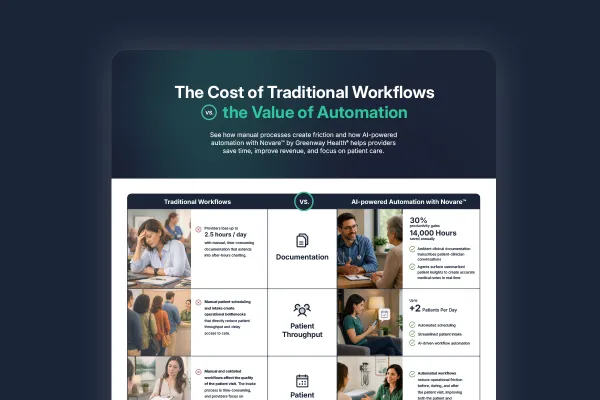
When work is redesigned around tools like ambient documentation and automated prior authorization, the recovered time goes wherever the practice needs it most. Some clinicians stop taking work home. Others see a few more patients or spend more time with the patients they have. Assuming demand, the recovered capacity typically offsets the technology investment. And the retention effect compounds quietly in the background: work that feels sustainable is work people stay in, which means fewer open positions to fill in the first place.
I know the objection. Some may assume we cannot fill our open positions, regardless of how we design the work. In some markets, that’s true. But the follow-up question still applies: can you make the work more attractive and reduce turnover? Every departure you prevent is a position you don’t have to fill. And practices that redesign their workflows often discover that the mix of positions they need changes, too.
Designing the system around the work
None of this happens just by deploying a tool. It requires a recognition that there is another way, and a willingness to embrace change to get there. It requires accepting that not every decision will be right the first time, keeping your eye on the trajectory rather than any single misstep, and celebrating the wins along the way.
It also requires infrastructure designed for it. This is the thinking behind Novare™, which Greenway Health® built as a reenvisioning of the EHR, with AI and automation as core functionality rather than features bolted on. The same questions a practice should ask about its workflows—is this task needed, can it be automated, who should own it—are the questions that shaped the platform itself. The EHR has historically been a way to record care. The goal now is to support the orchestration of care.
A physician at a practice using Novare told me recently that, with the workflow changes they’ve made so far, he saves 1 to 2 hours a day and no longer takes work home. No staffing forecast captures that outcome. But it is exactly the outcome that determines whether people stay in this profession.
Healthcare does not need to wait for a wave of new clinicians and other team members who may not be coming. It needs to redesign the work so that the people already here can do the jobs they trained for.
The shortage we keep measuring is people. The shortage we can actually solve is time.
About the author
Taking a team approach to healthcare technology A primary care physician at heart, Dr. Blackman brings an extensive background in health IT product management along with his knowledge of outpatient and inpatient care. He believes healthcare is a team sport that requires the talents of…
More by Dr. Michael Blackman